Founder's Journey With Prashanth Tondapu
Posted on Tuesday, Jan 20, 2026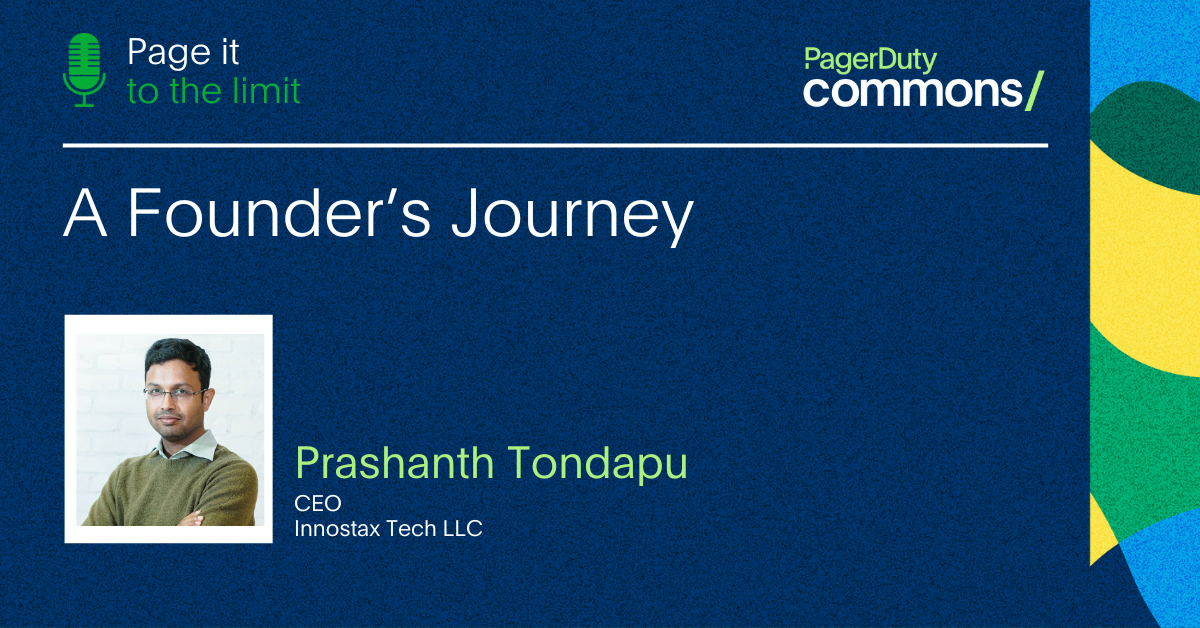
Transcript
Mandi Walls (00:09): Welcome to Page It to the Limit, a podcast where we explore what it takes to run software and production successfully. We cover leading practices used in the software industry to improve both system reliability and the lives of the people supporting those systems. I’m your host, Mandi Walls. Find me at LNXCHK on Twitter. All right. Welcome back to Page It to the Limit. Thanks for joining us again in this episode. Today I’ve got Prashanth with me and we’re going to learn a whole bunch of stuff about him. Sir, welcome to the show. Thanks for joining me today. Tell us a little bit about yourself and what you do.
Prashanth Tondapu (00:45): Thank you very much for having me. So I’m Prashanth Tondapu. I’m the founder of Innostax Tech LLC. I am a techie who started this company and landed up in a leadership role that I’m still growing into.
Mandi Walls (01:03): So tell us about that. Tell us a bit about your journey, like founding a company and learning how to manage folks and all that good stuff.
Prashanth Tondapu (01:12): So my journey is, I wouldn’t say unique, but it is definitely like a story, where I do not come from a business family. I come from a family where my dad worked in a cement industry.
Prashanth Tondapu (01:32): And so I did not know how to run business as such. And the initial leadership experience that I had was mostly around playing cricket and kind of where it’s a team sport. Tend to have some leadership exposure over there. Then I got into bachelor’s degree for computer science. Then I got into software development. I really liked it. And it was a time where icons were being created who were all part of software industry where you heard about Bill Gates, you heard about Steve Jobs, you heard about all these people who were in technology. So I obviously like most of the kids our age, like you want to become that. They are your idols. So I thought someday I will start a company. And I was doing software development for … I joined McAfee, company and I was a developer there. And logically I had to start a company because that was what I wanted as a child.
Prashanth Tondapu (02:48): And so I started a company and I wanted to do products because historically I was part of product companies and all the idols had product companies. I built four or five products. As a naive guy, I assumed that you sit in your living room, think about what the world wants and you build it and people rush through the door trying to use your products, which I couldn’t have been more wrong.
Prashanth Tondapu (03:17): So that was the first shock. I built everything. Then okay, people said, “Do Google ads.” I did some Google ads here and there. And then some people said, “You have to be where your customers are. " So there was one product that I built which was around ordering some food for some restaurant.
Prashanth Tondapu (03:40): So I got some pamphlets printed and I stood outside an office and gave it to them so that I thought they would kind of look at it and probably access my site. And meanwhile, through my phone, I was looking at Google Analytics to see if somebody really visited. Nobody did. So there were a lot of things. So that during that time, I was trying to meet as many people as I could to understand what I could do. So I met one guy who advised a couple of companies and he said that he helps founders like me who do not know what they’re doing. And he was helping another founder who was building a product and they did not have their tech guy. And he asked me, “Can you help him?” So I went there. They had a two people team, but the team was not skilled.
Prashanth Tondapu (04:30): In a way, even the founder was non-technical. He did not know who he was hiring. So the day I met him, he told me, “You are the director of engineering. You don’t have to code.” I was a software guy at 27. So I said, “Okay, I’m director of engineering. Sounds good. So let me go and I’ll help these guys.” But they did not even know basics. So I was a developer. I said, “Move aside.” And I coded the entire thing in a month and a half. And when I got paid, that’s the first time I realized, okay, so I don’t have to do products. I could do consulting. I could build after so much. That’s how I got into this industry.
Mandi Walls (05:04): Made your first pivot. Yeah, absolutely.
Prashanth Tondapu (05:07): Oh, that was the sixth or seventh pivot, by the way. There were a couple of things that I built which never really turned out didn’t pan out. Then with this, I realized I could do this. I used to work with a company called Advisory Board before I quit and tried doing all these products. So I started reaching out to people that I worked with in the US. I had a very good reputation of being a very good software developer. So I reached out and said, “So I can work in some capacity or the other, should we start doing services?” So my manager from the last company that I was working with, he said, “Oh yeah, definitely I have some side projects and I could give you something which you could work on. " And I did not know how much to charge even.
Prashanth Tondapu (05:56): “What is your hourly rate? “I said,” Okay, so I don’t know. I asked somebody, somebody said something. I said, “This is my hourly rate.” He said, “Fine, but I’ll give you this. " I said, “Fine, whatever.” I was happy with whatever. And that’s how consulting started, but obviously I gave blood and sweat to that. I was a good developer and my work ethic was on point always. I really take pride in my work, so I did really good over there. And then I got a couple of more projects here and there. Then I realized now I need to hire.
Prashanth Tondapu (06:28): So I don’t know how to hire because I was a junior guy in my team before. So I thought, how hard can it be? Probably there are a lot of people just around, you can hire anybody, they’ll do the same kind of work. Then I collaborated with, not collaborated exactly. There was this company that trained a few people who they would let you interview them and you could interview and select them if you wanted to. So they sent around 30 or 40 people to the office, interview them. I was one guy trying to ask them questions, but the quality was not great, but I thought the world is filled with really great developers and everywhere. And India is supposed to be filled with some really great developers. That was my assumption, and that was the first time my myth broke. But still, I ended up hiring few people.
Prashanth Tondapu (07:24): I had five or six people. And what I realized was, so I had like two or three people work and obviously my hires were not the right hires.
Prashanth Tondapu (07:36): I had to somehow deliver to the people that I have committed to. And I ended up working 16 or 17 hours a day because there was nothing I could do. They were there in the office, but they did not know what they were doing. And I was having these migraines. So to not have migraines, I used to have a tablet for headaches. The side effect for that was that you don’t feel sleepy, so you get more time to work on. And that was my first journey. And after some time I thought, okay, I have so many people, but why we are not able to deliver? And even firing was the first time for me. And I ended up thinking this is not working. I have to fire them. I went and met them and I asked, “See, this is not working.” Even they were, guys were saying, “What is not working?
Prashanth Tondapu (08:27): It’s great. We are coming and doing something.” I said, “You’re not doing anything.” And I had to let them go. Then that’s when I kind of started digging deeper on where do you post jobs and try to hire some good universities and all that. That is where I found a couple of people and some of them, like my CTO actually came from that effort. Right now, the guy who is my CTO, we grew together in a way where I understood how to be a CEO, he understood how to be a CTO, and now we are up to 85 people team. So that is the first journey to real leadership.
Mandi Walls (09:09): Yeah. Yeah. And it is one of those things that we see … Well, I think we’ve all seen it in technology. I’ve been in the industry quite a while, and it is hard to hire. It’s hard to know exactly how to prove that the folks that you’re hiring know the technologies they claim to know, but also know how to actually work. Yeah, there’s knowing the code, but there’s also knowing software development life cycle and those kinds of processes, and are you willing to learn, and can you work with other people? Because I think when we were kids, there was this mythos about software development that you just sit in a dark corner and hack on a computer all day by yourself. And that’s not how software gets built anymore. It’s too complex. There’s too much going on. You have to be able to have some interpersonal relationships and work as a team because the stuff that you’re not capable of building the entire system yourself anymore is just too complex.
Mandi Walls (10:05): So did you have some mentors or other folks that you looked for in your local tech community for advice? Or how did you sort of build up the skills around getting better at the whole process of managing and hiring folks?
Prashanth Tondapu (10:23): So most of the journey had been kind of figuring out when something broke and something was not working, what can we do better? So until like last four years ago, three and a half to four years ago, I never had a mentor or anybody who would kind of help me through this. So it was more around powering through. One way how it helped me was understand how you think as you grow and like it broke the illusion that you build something and you kind of build yourself, you just kind of build things in your head, you remove things that are not required and keep adding a little … But it’s mostly removing things that are not required because I believe until seven people team, anybody can run a team. Without much growth, you could be a control freak, you could be a guy micromanaging, you could be a person hovering.
Prashanth Tondapu (11:19): As soon as the number gets to eight, all these things break. It doesn’t work anymore. It doesn’t scale. And when that happens, you start looking, like you get frustrated, you start getting frustrated at why are these people not able to get it? But it takes some time and enough pressure on yourself to realize that you are the problem, not them.
Mandi Walls (11:43): Yeah.
Prashanth Tondapu (11:44): And so delegating with control is what you will have to learn. And even before delegating, I think you’ll have to learn trusting other people. You’ve always lived with yourself, you have 100% control on yourself, so it is very easy to trust you. But even though it sounds very naive right now, but as a guy who is a software developer, as software developers, we are too attached to the system. System does exactly what you wanted to do, but people do not. And as a software developer, leading a team, you expect people to be working based on the rules and regulations of protocol that you have set,
Prashanth Tondapu (12:26): People are complicated, much more complicated than your systems are. And yeah, from more than when we reached seven plus, I had to delegate things and hope they did not fail.
Prashanth Tondapu (12:40): And with the team that we had, I always felt that I was the smartest guy, which I was not, but that’s what I thought I was. And so I always thought if I stepped back, something will definitely fail. And that … So the CTO who I’m working with, and we have built the company together in a way, I let him read the call and I did not attend the call because I knew if I was on the call, I am going to hijack the call. And he did good. He definitely did good. And obviously, unless you’re exposed to things, you can never grow. So you have to expose people to the perspective that helped you grow and people do better than you actually a lot of times. So that perspective helped. Then as we grew along, one of the biggest learning for me was not taking things personally, because as a founder, when you are too involved, you have a tendency to internalize everything.
Prashanth Tondapu (13:39): Every escalation feel like you have to lose sleep over it, you were not good enough. Being able to disconnect from that has been the biggest evolution and understanding that their systems, they will fail. The point is not to brood over them and look at how you can improve the process.
Prashanth Tondapu (13:58): Understanding that you’re not supposed to blame people because people are people. That’s why there is this term called human error. Human error, human are supposed to error. Even ChatGPT that is built on the fundamentals of human intelligence hallucinates, what can we do? That’s how we are. So that was one of the big learnings that I had. Yeah.
Mandi Walls (14:19): And that’s such an interesting growth opportunity to learn all of that, not necessarily not just about other people, but about yourself as well, to sort of get that kind of reflection of like, okay, I have these sort of preconceived notions of me in my place and what I know, but once you add other people into the mix and you’re looking at, well, how do I interact with them? How do I help them get better? How do I make myself better in service of all of us improving and being successful? That’s a very interesting journey to go on, especially when you’re a founder of that kind of company and you feel like everything is probably riding on some of the decisions that you make. That’s a super interesting story.
Prashanth Tondapu (15:05): Yeah. One thing what I’ve realized is the day we stop thinking we are unique, right? That itself is a big growth because uniqueness that you attribute to yourself make you feel bigger than who you actually are. And like ChatGPT, based on how you speak, can create your persona and predict who you are, what your problems are, and a lot of things around you. That means it’s a pattern, right? It’s just a pattern. It’s based on like, we are LLMs and based on what data we are exposed to, we behave a certain way, but internally we are all the same model. And that realization actually makes you kinder to other people and yourself where fine, I felt emotional about it, the other guy felt emotional about it. The guy probably did not give his best because there is something that was affecting him and that actually takes away emotions from your decision making and always you come back to, okay, how I can make the environment better so that people thrive rather than what do I tell this guy so that he kind of performs better?
Mandi Walls (16:15): Yeah, absolutely. Because you have to give folks grace. Not everybody can be 100% every day. Honestly, that’s a pattern for burnout more than anything else. And that’s not what you want because then you lose everything that they have gained is if they end up quitting or going somewhere else because they can’t handle the environment, folks need some time to sit down and digest, I guess, what they’ve done. I love an afternoon where I can just sit and think about what we’re working on, what I can do better, but in a very unstructured kind of way. Sometimes I draw myself little pictures, sometimes I just make notes, but you need that little bit of that decompression time for your brain to catch up with what you’re doing. There’s so much going on, so many things flying at you all the time. And I think it’s definitely hard to back off on people when you’re very excited or very invested in the success of the organization.
Mandi Walls (17:09): Sure.
Prashanth Tondapu (17:10): Absolutely.
Mandi Walls (17:13): So what is new and what kinds of things are you looking at in new projects for this year? Like you’ve mentioned ChatGPT a few times. How is that changing your methodologies and the things that your teams are working on? Are you seeing a lot of success there with the different AI products? Internally, we’ve been using a bunch of them for different things. We’re incorporating stuff into our products as well that leverages those kinds of technologies. It’s kind of in the forefront of everyone’s mind right now. So how’s that impacting what you’re doing?
Prashanth Tondapu (17:46): So first thing when we look at AI, first it looked like a threat before threat to the industry as such, the software consulting industry as such. But the more we are exploring it, it is a very good tool. And there is an analogy where I heard somewhere where people said there are two types of horses. One is a domesticated horse and one is a wild horse.
Prashanth Tondapu (18:13): So the code that you write is basically domesticated horse. And the code written by AI is this wild horse. Any day you look, wild horse is very fast, very powerful, mighty, elegant, everything. The day you want to ride it. Not going to happen. Yeah. So that is where we are. We have tried using as much AI as possible into the process because we have to upgrade, we have to adapt with the current ongoing market. So we have a team constantly trying to build our internal things with AI and then trying to maintain it. So that is like one of the pet projects that we are trying to have so that with the predictability, we are able to measure on exactly how much real generatable velocity we can have. So now we are using cloud extensively in the company. We definitely have got a lot of speed, but the expectations in the market are very unrealistic.
Prashanth Tondapu (19:15): People who have not really used that for development expect it to be 500 tons faster because anytime people go and use Lovable, say, generate this for me, generates a lot of things. But once you analyze the code, you will see the amount of tech debt there is. So for our engineers, you could use whatever you want, but the checkpoint is the PR. The PR needs to be human reviewable. Like you use wild horse, wild donkey, whatever you want to get to that point. But for that code to be agreeable, the peer reviewers are going to look at it from a human lens and they’re going to evaluate whether they’re able to put a saddle on it or not. If not, then it could be doing world’s most amazing things, but if it is not controllable, it’s not worth it. It’s not going in. It is just a recipe for disaster waiting to happen.
Prashanth Tondapu (20:07): One day you want to get on that horse, it would have taken your trolley wherever it is and you can’t even get to the horse or your own trolley. So that’s what we are kind of skeptical about and playing safe on that particular piece.
Mandi Walls (20:20): Yeah. And do you find that folks are enthusiastic about it or like you said earlier, it looked like a threat for software consulting. Do you find in your teams that they’re excited about using it or still have some concerns?
Prashanth Tondapu (20:36): It depends on people. The people who have been in the system longer are very skeptical because people with experience, they know what can go wrong with one line of code change. And your guys who are coming in seem very optimistic about it. People have not been exposed to real production systems and they seem very optimistic. “Oh, wow, I built this thing in like four hours. Yes, you did it, but now keep try to add 10 more features on top of this.”
Mandi Walls (21:05): Yeah, it has to live for a while. We have to add stuff to it later.
Prashanth Tondapu (21:09): Absolutely. So we see some pushback on that level where people are saying, “Just open it up.” Even there are some of the clients saying that, “I heard somewhere that it is 500 times faster, but how are we getting the value out of it? " It’s a hard time explaining to them that’s where we have our, this is the PR generated by it. There’s 3,000 lines of code generated in 10 minutes. And this is like 30 lines of code generated in an hour. I would rather pick that 30 lines of code generated in an hour. It doesn’t follow DRY properly. If you go by Lovable, it goes in different tangents. With Claude, the key is to keep the context small. When you give the context small, even some basic addition functions, it makes mistakes. How do you explain that? It made an additional mistake, it hallucinates.
Prashanth Tondapu (21:57): So every line of code written, the amount of testing, like the time you write code might have decreased, but the amount of time you spend on testing your own code has increased significantly because you can’t trust anything.
Mandi Walls (22:10): Absolutely. Yeah. And yeah, I find it super interesting and some of the stuff folks are doing with it obviously is fun to watch. I have a few friends that are playing with different things and some of it seems silly, I guess, so far as they’re just kind of flexing it and learning about what to do. But like you said, you want this, you’re going to build this product, you’re going to invest all this time and effort into it. You want it to run for a while. So what the life cycle of these sort of partially generated assets look like over time is going to be interesting as those things continue to age, I guess we could say once they get some burn in and see how they actually behave and then what you’re going to do with them over time when you, like you said, want to add stuff to them or they’re no longer performing the way you want to.
Mandi Walls (22:58): Who knows enough about what you put in there to go in and do the mechanics on it to improve it? And will the models be able to help you with that? We hope so, but if they could, why didn’t they give that to you the first time around? But it’s been interesting to see what folks are doing with it and what it’ll do for us in the future. So with that in mind, how do you train up new folks as you bring them onto your team? I’ve talked to new graduates and I’m like, “Yeah, they’re learning different stuff than I did when I got my computer science degree, but at the same time, it’s not like you can just plop them down at a desk and give them some tickets to work on and they’re going to be successful.” There’s still that sort of like, “Here’s how to do real work and you have to train the puppies how to be dogs.”
Mandi Walls (23:45): What’s your process for bringing new people on board in your organization?
Prashanth Tondapu (23:49): So we have been doing this for 12 years now. So our process is pretty solid for to say. Whenever somebody new joins, we have our own products. We have our own set of products. The grand vision is not to kind of make them really big products. If they become, it’s fine, but all throughout the year, the R&D doesn’t stop.
Prashanth Tondapu (24:13): This is our workshop where you are trying to sharpen your axe in a way as a company. So all the new folks first joined that R&D team. So what happens over there is they are following all our processes that we use with our clients, like how we work, how the ticketing is assigned and how the decisions are made, what the code qualities is maintained. And even the senior folks on those projects are kind of exploring how much AI can be pushed. So all this, they become part of that and they graduate after a month or so where they understand that this is the procedure, this is how we work, this is the process. You have freedom, but you cannot transcend this guard rings because as a services industry, our focus is more on the quality, the velocity and the predictability. So once we cannot compromise on that.
Prashanth Tondapu (25:15): If we were a product company where the most value add was on the product and kind of creative side of it, it would have been different. So we had to kind of make sure the guardrails are pretty solid and the quality is across the code quality rules that we have. The philosophy is that for us, code quality is not writing the most beautiful code. It is not being able to tell who wrote which part of code. It is that consistent. Like tomorrow you’re gone, somebody else comes in and it looks like everything is written by a single guy. So those kind of standards is how we enforce and the new folks get a break into the culture that way.
Mandi Walls (25:53): Yeah. That sounds excellent. Very nice. All right. So we’re just about at time. You have learned things the hard way, it sounds like for a long period of your career. Is there anything that stands out as something that you wish you had known when you were starting out that you wish you hadn’t had to learn the hard way that someone had given you a heads up on?
Prashanth Tondapu (26:15): I think the journey would be same for everybody, but the main opening comes when you understand that you do not know everything. So there is a book called Mindset that I recommend people to read. So first time when I read that book, everything written about fixed mindset was me. I got where I got to based on the skills that I had. So I thought like my skills in the sense having the control, like having very strong conviction that this is the only right way to do and that’s the reason I’m here. But understanding that what got me here will not take me further. There is lot that I do not know. Saying is easy, but like really internalizing that growth mindset. I think that will make the entire difference. The world has so many things to offer you if you’re willing to slow down and listen and kind of like introspect and having the growth mindset will let you do that.
Prashanth Tondapu (27:08): Otherwise, all the data is just passing noise.
Mandi Walls (27:11): Yeah. We’ll link that in the show notes. I just looked it up on Amazon. I actually bought it in 2013 and probably did not read it because I have a problem with doing that with books, but we’ll put that back on the top of the TBR list. Yeah, that sounds great. And so to wrap us up, what are you most looking forward to this year? What’s on the horizon for you that is exciting or that inspires you to keep going?
Prashanth Tondapu (27:36): So we are moving from, this is a declared thing in our company right now, that we were an outcome-based company before. Then we became a process-driven company. This year is about becoming people first company where we have processes in place, but the focus will be to develop people for their life beyond InnoStax. So it’s kind of transcending the transactional value of the relationship between the employees and InnoStacks where we are investing in the leadership trainings and the processes are going towards being people centric in a way, empowering people and people give it back to the company rather than company telling them exactly what they need to do and trying to live up to that as much as possible. We have made a lot of changes from October onwards and we are pushing for that. That has become our core pillar for this year.
Mandi Walls (28:34): That’s great. That’s awesome. Well, thank you so much for your time. If folks want to learn more, do you have an online presence or social media that folks can follow to hear more from you?
Prashanth Tondapu (28:44): I’m on LinkedIn and I’ll be happy if somebody just wants to talk from technology standpoint or discuss more on leadership. They could reach out to me on LinkedIn or they could book some time on my calendar on the website. It’s there, Innostax.com, our company website.
Mandi Walls (29:03): Excellent. We’ll link that in the show notes as well. Sean, thank you so much for your time. This has been super interesting. Like I say, I am not a founder. I also come from a blue collar background. My dad was a mechanic, so it was not anything that I ever thought to found a company. So it’s always interesting to hear these stories from folks. I hope everybody out there learned a little bit today about you grow with your company. It’s a learning experience for everyone. So it’s been great to chat with you and appreciate your time.
Prashanth Tondapu (29:32): Thank you very much and thank you for having me on the show and really appreciate it and hoping to stay in touch.
Mandi Walls (29:40): Absolutely. And for everybody out there, thanks for joining us this week. We’ll be back in a couple weeks with another episode. In the meantime, we’ll wish you an uneventful day. That does it for another installment of Page to the the limit, we’d like to thank our sponsor, PagerDuty, for making this podcast possible. Remember to subscribe to this podcast if you like what you’ve heard. You can find our show notes at pageitothelimit.com and you can reach us on Twitter at pageitothelimit using the number two. Thank you so much for joining us and remember, uneventful days are beautiful days.
Show Notes
Additional Resources
- Innostax
- Mindset, The New Psychology of Success by Carol S. Dweck
- Join the PagerDuty Commons!
- PagerDuty Home Page
- Episode edited by Mandy Moore
- Transcripts by Rev
Guests

Prashanth Tondapu
Prashanth Tondapu is the Founder and CEO of Innostax, a $3M ARR software services company built on a simple but uncommon idea: engineers should own outcomes, not just code. His career has been defined by being the engineer others turn to when things go wrong, a mindset that became the foundation of how Innostax was built.
He founded Innostax to eliminate the “body shop” model in offshore services, replacing it with managed teams led by accountable tech leads. With a unique two-week free trial and one-day termination notice, Innostax serves companies like Intel, Autodesk, and Travelstart, delivering 300–400% faster outcomes with smaller teams through ownership, clarity, and discipline.
Hosts

Mandi Walls (she/her)
Mandi Walls is a DevOps Advocate at PagerDuty. For PagerDuty, she helps organizations along their IT Modernization journey. Prior to PagerDuty, she worked at Chef Software and AOL. She is an international speaker on DevOps topics and the author of the whitepaper “Building A DevOps Culture”, published by O’Reilly.